The True Cost of Sitting: A Nepali Developer’s Guide
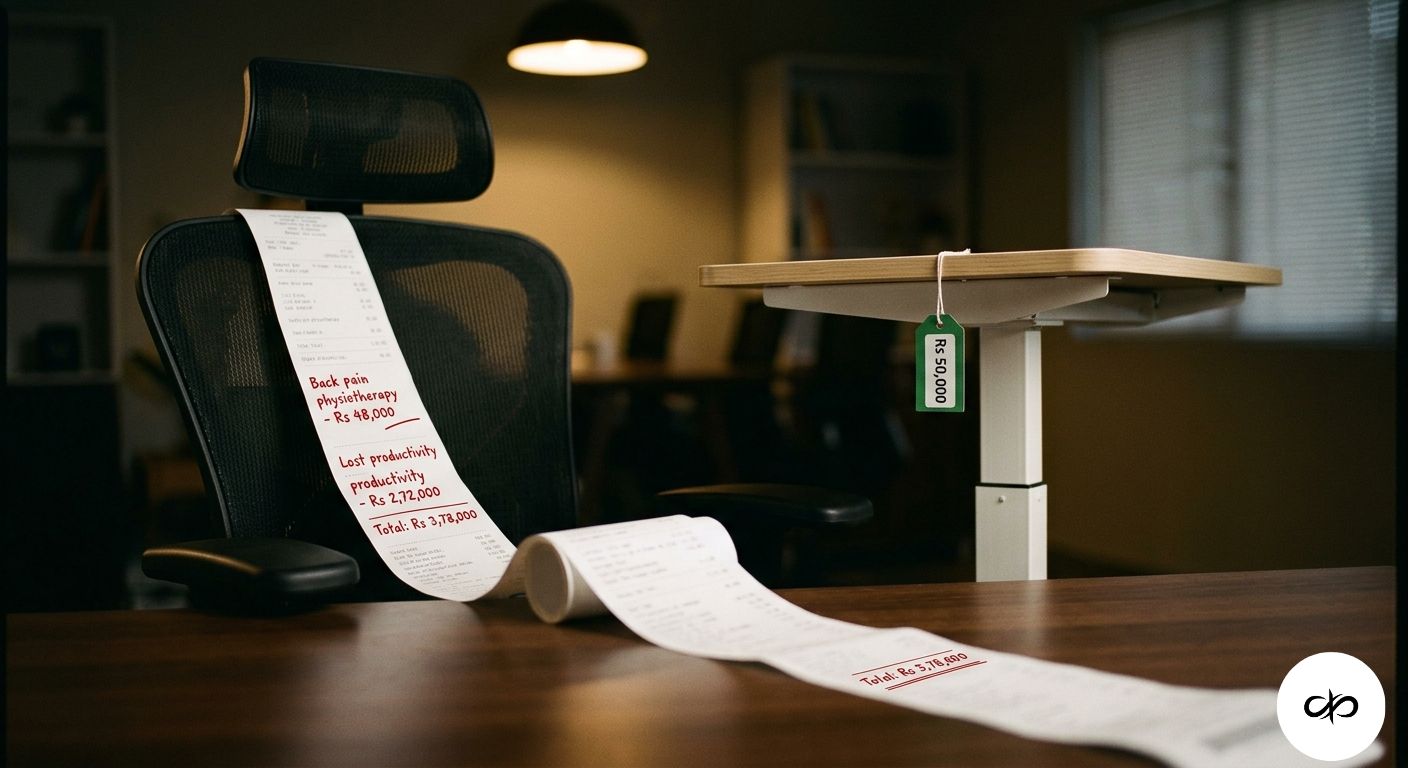
Sitting for 8 hours a day costs the average Nepali developer NRs 3.78 lakhs per year.
Not in the chair. Not in the desk. In the medical bills, the lost productivity, and the missed career opportunities that nobody talks about.
Most people don’t know this. They think back pain is just part of the job. They think the occasional physiotherapy session is normal. They think the afternoon slump is just how work feels.
It’s not. It’s a cost. And it’s eating your salary.
Here’s the exact math.
Sujan’s Story: The Developer Who Sat Too Long
Sujan was 28. He had 4 years of React experience. He made NRs 80,000 per month at a Kathmandu startup. He was the kind of developer every company wants: sharp, reliable, and always online.
He also sat for 10 hours a day.
The first warning signs appeared at 26. A tightness in his lower back. A stiffness in his shoulders. He ignored it. Everyone has back pain, he thought. It’s part of the job.
At 27, the tightness became pain. He started taking breaks every hour to walk around. His manager noticed. “Sujan seems distracted,” he said in a team meeting. Sujan wasn’t distracted. He was in pain.
At 28, his back went out.
It wasn’t dramatic. He bent down to pick up his laptop bag and felt something snap. He couldn’t stand up straight. He couldn’t sit. He couldn’t work.
The cost:
- 2 months off work (lost salary: NRs 160,000)
- 12 physiotherapy sessions at NRs 2,500 each (NRs 30,000)
- 4 doctor visits at NRs 1,500 each (NRs 6,000)
- Pain medication for 3 months (NRs 4,500)
- A missed promotion (estimated value: NRs 20,000/month raise, lost)
- A side project he abandoned (potential revenue: unknown)
Total visible cost: NRs 200,500.
But the invisible cost was worse. The lost momentum. The damaged reputation. The fear that it would happen again.
Sujan’s story isn’t unique. It’s the median experience of Nepali developers who sit for 8-10 hours a day.
And here’s what most people don’t know: it wasn’t a dramatic injury. It was math.
8 hours/day × 250 workdays/year × 4 years = 8,000 hours of sitting. The human spine isn’t designed for that. Something was going to break.
The Math: What Sitting Actually Costs You
Let’s be precise. The cost of sitting has two components: direct medical costs and lost productivity costs.
Direct Medical Costs
These are the bills you pay. They’re visible. They’re painful.
| Item | Cost (NRs) | Frequency | Annual Cost |
|---|---|---|---|
| Back pain physiotherapy | 2,000/session | 2 sessions/month | 48,000 |
| Chiropractic visits | 1,500/session | 1 session/month | 18,000 |
| Pain medication | 500/month | 12 months | 6,000 |
| Massage therapy | 2,500/session | 1 session/month | 30,000 |
| Doctor consultations | 1,000/visit | 4 visits/year | 4,000 |
| Subtotal | 106,000 |
This is conservative. Many developers don’t seek treatment until the pain is severe. By then, costs double. MRI scans, specialist referrals, and potential surgery can push the lifetime cost into lakhs.
Lost Productivity Costs
These are the costs you don’t see. They don’t show up on a bill. But they show up in your career.
| Issue | Hours Lost/Week | Value (NRs/hour) | Annual Cost |
|---|---|---|---|
| Afternoon fatigue (sitting slump) | 5 hours | 500 | 120,000 |
| Back pain breaks (stretching, walking) | 2 hours | 500 | 48,000 |
| Sick days (back-related) | 2 days/quarter | 4,000/day | 32,000 |
| Reduced focus (discomfort) | 3 hours | 500 | 72,000 |
| Subtotal | 272,000 |
Total annual cost: NRs 378,000 (NRs 3.78 lakhs).
For a developer making NRs 80,000 per month (NRs 960,000 per year), sitting costs 39% of their annual income.
Not their salary. Their income.
The Nepal-Specific Problem: Why It’s Worse Here
If you work in San Francisco, you have options. Ergonomic assessments. Standing desks in every office. Health insurance that covers physio.
In Nepal, you don’t.
Healthcare Access Is Limited
Kathmandu has physiotherapists, but the good ones charge NRs 2,500+ per session. In Pokhara, Bharatpur, or Butwal, options are scarce. Many developers never see a specialist. They self-medicate with painkillers until the pain is unbearable.
And health insurance? Most Nepali tech companies don’t offer it. The ones that do often exclude “ergonomic injuries” as “lifestyle conditions.” You’re on your own.
Work Culture Normalizes Overwork
10-hour days are common in Nepali startups. “Startup life” means sitting longer. There’s no HR department in a 15-person company. There’s no ergonomic assessment. There’s no policy.
The culture is “tough it out.” Developers ignore pain until it’s severe. By then, the damage is permanent.
The Commute Multiplies the Problem
Many developers sit for 1-2 hours in Kathmandu traffic before sitting for 8 hours at work. That’s 10 hours of sitting before the workday even starts. The body never gets a break.
And public transport? Standing in a packed bus isn’t the kind of standing that helps. It’s the kind that exhausts.
The Age Paradox
Nepali developers are young. The average is 26-30. But chronic back pain is hitting earlier. 20% of 25-year-olds in tech report chronic back pain. By 35, the damage is often permanent.
You’re not old. But your spine thinks you are.
The Career Cost: What Nobody Talks About
Back pain doesn’t just hurt your body. It hurts your career.
The Missed Promotion
You can’t lead a team if you’re in pain. Managers notice when you’re distracted, when you take long breaks, when you miss days. They don’t think “back pain.” They think “unreliable.”
Sujan missed a promotion because of 2 months off. The promotion went to a developer who sat at his desk for 12 hours a day without complaint. The manager didn’t know that developer was also in pain. He just never took time off.
The Failed Interview
You can’t code for 8 hours in a take-home assignment if your back hurts. You can’t focus on system design questions if you’re thinking about your chair. You can’t perform at your best if your body is failing.
The best developers lose opportunities because of pain. The pain doesn’t show up in the interview feedback. It just shows up as “not a good fit.”
The Dead Side Project
Every developer has a side project. An app. A tool. A SaaS. Something that could become income.
Back pain kills side projects. After 8 hours of sitting, you have no energy to code. You have no focus to debug. You have no creativity to design.
The side project dies. The potential income dies. The dream dies.
The Freelance Rate Drop
Clients notice when you miss deadlines. Back pain is the #1 reason freelancers miss deadlines. Not laziness. Not poor planning. Physical pain.
Missed deadlines mean lower ratings. Lower ratings mean lower rates. Lower rates mean less income. The cycle compounds.
The framing: Your back is a career asset. Treat it like one.
The Calculator: What’s Your Number?
Here’s the formula. Calculate your own cost in 60 seconds.
Your Sitting Cost = (Hourly Rate × Hours Lost/Week × 48 Weeks) + (Annual Medical Costs)Your hourly rate: Monthly salary ÷ 160 hours (standard work month).
Hours lost per week:
- Afternoon fatigue: 3-5 hours
- Back pain breaks: 1-2 hours
- Reduced focus: 2-3 hours
- Total: 6-10 hours
Annual medical costs:
- If you have mild back pain: NRs 30,000-50,000
- If you have moderate back pain: NRs 50,000-100,000
- If you have severe back pain: NRs 100,000+
Example Scenarios
| Developer Profile | Monthly Salary | Hourly Rate | Hours Lost/Week | Medical/Year | Annual Cost |
|---|---|---|---|---|---|
| Junior (2 yrs) | NRs 40,000 | 250 | 5 | 30,000 | 90,000 |
| Mid-level (5 yrs) | NRs 80,000 | 500 | 7 | 50,000 | 218,000 |
| Senior (8 yrs) | NRs 150,000 | 940 | 8 | 70,000 | 430,600 |
| Freelancer | NRs 200,000 | 1,250 | 10 | 40,000 | 640,000 |
The insight: The more you earn, the more sitting costs you. Senior developers lose 3x more than juniors. Freelancers lose 7x more.
Why? Because your time is worth more. Every hour lost is an hour you could have billed. Every hour of fatigue is an hour of suboptimal work. The cost scales with your value.
The ROI: Why a Standing Desk Is the Best Investment You’ll Make
A standing desk costs NRs 50,000.
Sitting costs NRs 378,000 per year.
That’s a 7.5x return on investment in year one.
After year one, the desk is paid for. Every year after that, you save NRs 378,000.
Over 5 years: NRs 1.89 lakhs saved.
Over 10 years: NRs 3.78 lakhs saved.
And that’s just the money. The health, the career, and the quality of life are priceless.
The 30-Day Transition: How to Start Without Quitting
Most people fail because they try to stand all day on day one. That’s like running a marathon without training.
Week 1: Stand 30 minutes per day
- Use a box on your current desk. No cost.
- Stand for 30 minutes in the morning.
- Sit when you feel tired.
Week 2: Stand 1 hour per day
- Split into two 30-minute sessions.
- Morning and afternoon.
- Notice how your energy changes.
Week 3: Invest in a standing desk
- You’ve proven the concept. You feel better.
- Buy a height-adjustable desk. See our options.
- Cost: NRs 50,000. ROI: 7.5x in year one.
Week 4: Stand 3 hours per day
- Alternate every hour: sit, stand, sit, stand.
- Listen to your body. Don’t force it.
The rule: The goal is movement, not standing. Alternate. Move. Change positions.
How to Convince Your Employer (The Exact Pitch)
If you’re an employee, you need to convince your boss. Here’s the pitch.
“A team of 5 developers costs you NRs 1.89 lakhs per year in lost productivity. That’s 5 people × NRs 378,000 = NRs 1,890,000.
“5 standing desks cost NRs 2.5 lakhs.
“The desks pay for themselves in 16 months.
“After that, you save NRs 1.89 lakhs per year.”
Add the HR angle: “Standing desks are a retention tool. Developers stay where they’re comfortable.”
Add the PR angle: “We can post our standing desk setup on LinkedIn. It’s good employer branding.”
Add the tax angle: “Office equipment is a business expense. It’s deductible.”
The email subject line: “NRs 1.89 lakhs per year: the cost of our current desk setup”
The result: Most startup founders in Nepal are developers themselves. They get it. They just need the data.
The Employer Cost: What Companies Are Losing
If you’re an employer, here’s your cost.
| Team Size | Annual Sitting Cost | Standing Desk Cost | Payback Period | Annual Savings |
|---|---|---|---|---|
| 5 developers | NRs 1,890,000 | NRs 250,000 | 1.6 months | NRs 1,640,000 |
| 10 developers | NRs 3,780,000 | NRs 500,000 | 1.6 months | NRs 3,280,000 |
| 20 developers | NRs 7,560,000 | NRs 1,000,000 | 1.6 months | NRs 6,560,000 |
The framing: Every month you delay costs you NRs 157,500 per 5-person team.
That’s not a desk. That’s a leak.
Sujan’s Update: 18 Months Later
Sujan is 30 now.
He’s been using a standing desk for 18 months. He stands for 3 hours per day. He hasn’t been to a physiotherapist in 14 months.
He got the promotion he missed. He’s leading a team of 4. He started a side project. He’s building a tool for Nepali freelancers.
He says the NRs 50,000 desk was the best investment he ever made.
“I used to think a desk was furniture,” he told me. “Now I think it’s infrastructure. Like the internet. Like the chair. You can’t work without it.”
The Most Important Number
Here’s the number that matters.
NRs 50,000.
That’s the cost of a standing desk.
That’s also:
- 1.3 months of physiotherapy
- 2.5 months of pain medication
- 12.5 hours of lost productivity
- 1% of the annual cost of sitting
Most people don’t know that a standing desk costs less than one month of back pain treatment. Be the person who tells them.
Calculate Your Cost. Share This. Stand Up.
- Calculate your hourly rate: Monthly salary ÷ 160.
- Estimate your hours lost per week: 6-10 is normal.
- Add your annual medical costs: Be honest.
- Multiply: Hourly rate × hours lost × 48 + medical costs.
- Compare to NRs 50,000: The desk is cheaper.
Share this with someone who needs to see it.
Tag a developer who complains about back pain. Forward this to your manager. Post it in your office Slack.
Your back is a career asset. Treat it like one.
What I Use
I switch between sitting and standing at my Karma Yantra desk. The height-adjustable frame goes from 70cm to 120cm. One desk fits every Nepali—from 4’10” to 6’4”.
Calculate your exact desk height: desk.karmayantra.com/height-calculator
See all standing desk options: desk.karmayantra.com/products
*Have your own sitting cost story? Email me at contact@karmayantra.com